Professor Matthews
English 101
01 December 2008
History has a tendency to repeat itself when government leaders do not learn from the past. In late October 1929, the United States faced one of the worst economic collapses in the history of the industrial world. During this time, many Americans suffered through a long period of financial struggles before regaining confidence in the market and their government. Fortunately, in 1932, Democrat Franklin Delano Roosevelt became the President of the United States, and with his drastically new ideologies that came in the form of the New Deal, he was able to restore the trust of the consumers. Recently, America’s economy has also reached a downturn as many economists claim that the nation will incur a long recession if it is not in one already. During October 2008, stocks on Wall Street fell almost 20% as many major banks collapsed (“.DJI”). As a result of this crisis, many of Barack Obama’s supporters hope that Obama will be the next FDR to the nation’s current economic problems. The conditions that Obama will face as the next president of the United States are similar in terms of the economic state met by FDR during the 1930s as economists note that the U.S. is in the worst financial disaster since the Great Depression. While faced with a comparable crisis, Mr. Obama also possesses similar attributes and political philosophies in comparison to Roosevelt as people look towards Obama to solve the current economic disaster in the same manner that FDR did during the Depression.
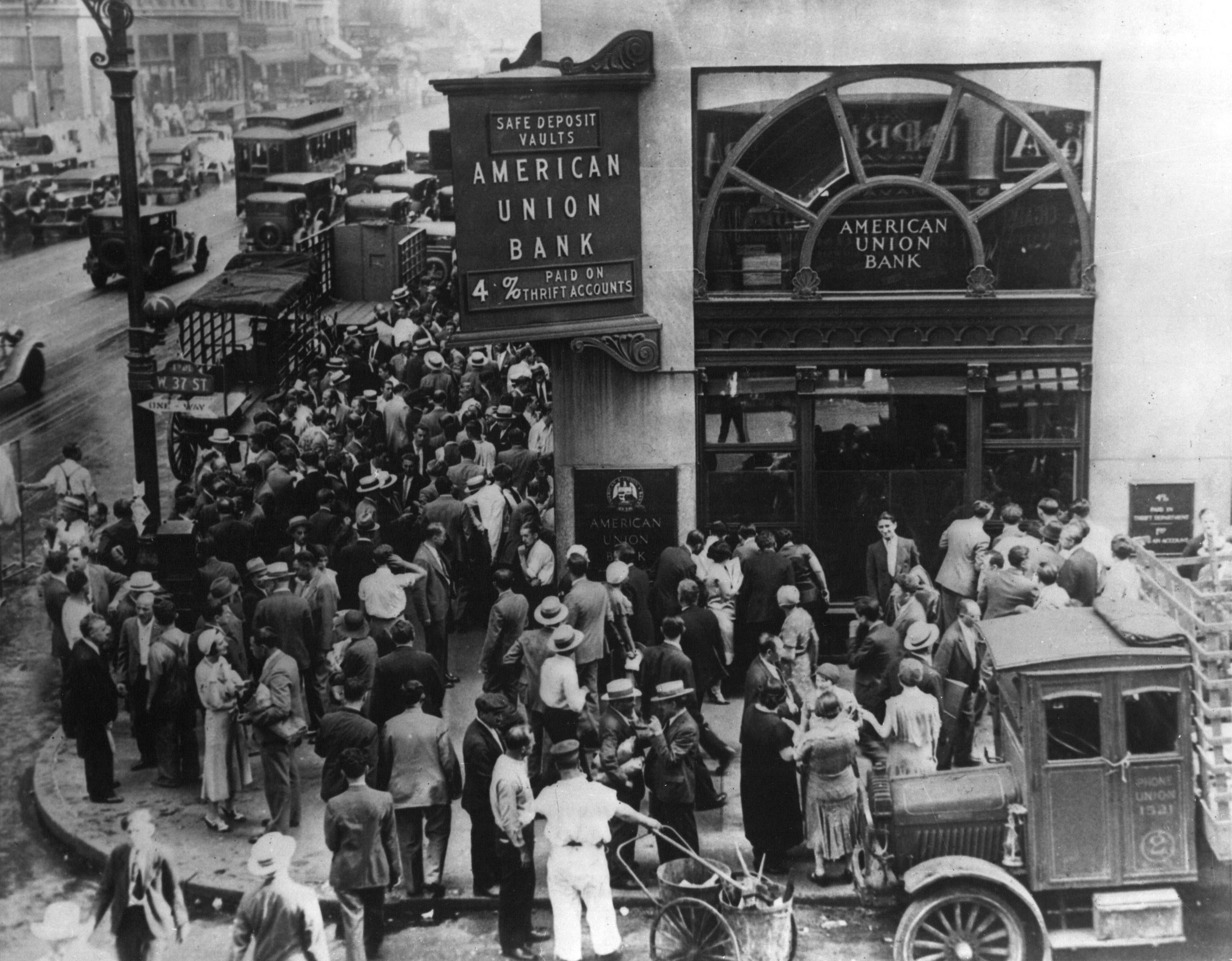
During the Roaring Twenties, the façade of the American economy could not appear more appealing to consumers and investors. This era of the United States emphasized individualism and the ideal of getting rich and chasing ones material pleasures. The economy was prosperous as a result of many new inventions and luxuries that better accommodated people’s lives, and the development of the credit system made it easier and more enticing to acquire these items. However, despite the booming economy and the success of many industries, there were subversive issues that were at work to bringing down the economic growth. Throughout the 1920s, wealth going to the richest grew, and by 1929, incomes were unevenly distributed; the top 0.1% of the population, which consisted of the wealthiest families, had the equivalent total income to the bottom 42% of society (“Great Depression”). Businesses had great success as a result of the economy’s increased demand and they were able to utilize their workers at low costs. On the other hand, since the working class received such a small portion of the wealth, many families could not afford the lives that they were living and accumulated large amounts of debt. The stock market was also a tempting place for investors to place their money as many less-affluent investors invested on margin (“Great Depression”). However, the confidence of the investors faltered in 1929 as they began selling stocks and the speculative bubble burst. Stocks fell over 70-80% as the stock market crashed, and unemployment skyrocketed to 26% as a result of the cut in production and the closing of factories. Bank depositors wanted to protect savings by withdrawing their money, but banks had nothing to give them (“Great Depression”). As banks failed, people panicked and mortgages on homes foreclosed. The Great Depression was the worst and longest economic collapse in the history of any developed nation and Americans suffered through tough times before former president Franklin Delano Roosevelt led the nation into World War II.

While the United States is not currently in an economic depression, the economy that Barack Obama will face as the next president has many parallels with the conditions of the 1930s. In October 2008 alone, stocks prices on Wall Street fell over 25%, and in the last year, over 45% (“.DJI”). While this is not as drastic as the 75% plummet in prices during the Great Depression, the current crisis on Wall Street is definitely a concern for many investors as corporations’ values plunge and many families find the value of their investments in the form of 401k, mutual funds, and stocks depreciate at a rapid rate. With poor investor and consumer confidence, the flow of money in the market system will be limited, thus worsening the overall economic conditions. The contemporary financial crisis will pose as one of Obama’s first challenges in the White House just as the Depression was at the top of FDR’s agenda.

(click to enlarge)
Similar to the Great Depression, America’s economic state is currently seeing a collapse of the banking system. While in the 1930s, banks failed because depositors lost faith in the system and began to withdraw savings, modern banks are collapsing as a result of the sub-prime mortgage situation plaguing the U.S. housing market (“What is”). In the last few years, lenders granted many sub-prime mortgage loans to borrowers with shaky credit and charged them higher interest rate in order to earn additional profits (Elder). However, when the rate of sub-prime mortgage foreclosures increased dramatically to one out of every five borrowers, the highest rate of foreclosures since the Great Depression, many lenders were in trouble and faced bankruptcy (“Subprime”). As a result of this meltdown, many mortgage lenders, such as Lehman Brothers, Freddie Mac, Fannie Mae, and AIG, collapsed in September 2008 and the government took over several of these firms in order to save the market. With failures in the current banking system, consumers and investors are negatively impacted and the Obama administration must effectively address their fears, just as FDR did during the first 100 days, to prevent the state of the economy from entering into a deep recession.

In addition to the troubling news about plummeting stock prices and the meltdown of many major banks, the current unemployment rate is another great concern to Obama and his administration even though it is no where as high as the numbers from the Great Depression. In the 1930s, many businesses were closing, factories were cutting productions, and a major portion of the capable population was out of work. Unemployment rates rose to over 25% as people who were making small salaries before the Depression were unable to secure a job afterwards. Although today’s 6.5% rate of unemployment is significantly lower than a quarter of the employable population, there is a subtle pattern of increasing rates as many of U.S.’s white collar professions are being shipped abroad (Nocera; Raynor). Today, many companies in the labor market outsource more jobs to foreign nations in order to increase efficiency and decrease costs of production. Some can argue that this is positive because it allows businesses to produce more final output with a lower cost input. As a result of this, families will be able to purchase products at a lower price, leading to a higher standard of living. However, from the nationalistic point of view, when jobs are outsourced, the nation’s gross domestic product, or GDP, declines, and people who are not employed are less likely to look for jobs, especially ones in which they are underemployed. The current unemployment rates are not as destructive as the high rates of the Great Depression because there is not a significant decrease of demand in the market; however, the policies outlined in Obama’s campaign still view this as a serious issue that his administration must address to improve the general welfare of society when he enters the Oval Office.


Although people frequently compare the economic conditions of 1932 and 2008, another interesting comparison is one that juxtaposes former president Herbert Hoover to George W. Bush. Before the inauguration of Franklin D. Roosevelt into the White House, the previous president, Herbert Hoover, was ineffective in addressing the issues behind the Depression. In today’s context, President Bush’s actions as the president were similar in that he was unable to relieve the problems facing Americans in the economic downturn. In the early 1930s, Hoover stated that the economy was fundamentally sound and that prosperity would soon return (“Great Depression”). He believed that that it was necessary to restore consumer confidence so businesses would invest and expand again, thus leading to higher employment and income to restore the strength of the economy. However, when sales remained stagnant and businesses saw no reason to expand, investments dropped to less than five percent of the 1929 level (“Great Depression”). Hoover then decided to raise taxes and cut government spending in order to balance the budget, but it further reduced consumers’ demand and worsened conditions as people who were struggling to make ends meet suffered even higher tax rates. Finally, Hoover provided government emergency loans to banks and industries, expanded public work programs and helped states offer relief to Americans, but it was already too late. He also emphasized voluntary and charitable giving, but there were too many people who were in need of aid (“Great Depression”).

Similarly, Bush was ineffective for the most part in dealing with the current economic slump because of his incompetence. Currently, America’s national debt is constantly increasing, and the war in Iraq is not relieving the situation as World War II did when it ended the Great Depression. Because of the poor economic conditions and the dollars wasted on a war waged with the wrong nation, President Bush has suffered an abysmal approval rating of below 30% since 2007, and even lower ratings since the economic crisis in late September 2008 ("Bush: Job Ratings"). When Bush attempted to pass the bailout plan in order to assist the failing financial sector, his own party in the Congress failed to rally behind their president as the House rejected the bill the first time. Although Congress passed the bill the second time it reached the floor, many economists still have heavy doubts about the plan because companies will lack the incentive to save themselves and expect the government to bail them out. As a result of Bush’s poor response to the financial problem that has been on-going for years before the current crisis, some Americans may compare the Bush administration to the Hoover administration for the failures in preventing their respective economic disasters.
Americans mention the adverse economic conditions and the incompetence of the preceding presidents when viewing these two time periods, but they also see a connection between the characteristics and political identity of Franklin Roosevelt and Barack Obama. Despite the bleak conditions in which FDR entered the White House, he was a confident politician who, during his inaugural speech, declared that “the only thing we have to fear is fear itself” (Riechmann). With a combination of audacity, inspiration, and innovative policies, Roosevelt lifted the nation’s spirit through his policies contained in the New Deal package. Soon after his inauguration, Roosevelt passed emergency legislation that established a national bank holiday, closing all banks to prevent depositors from withdrawing their money, and reassured Americans that the banks that would reopen safely. FDR’s New Deal attacked unemployment by creating many programs that assisted businesses and regulated banking and stocks. The deal also attempted to increase demand by injecting large amounts of money into the economy through public works programs and relief measures, which also provided jobs and developed infrastructures such as schools, roads, and dams (“Great Depression”). Although FDR did not single-handedly lift the U.S. out of the Great Depression, he did help America survive through it. It was not until the onset of World War II that America was truly out of the economic disaster, but nevertheless, many commend Roosevelt for his bold actions as the chief executive that allowed the U.S. to regain some of its economic strength before entering the war.
FDR Inauguration Speech: (0:26-1:55)
As the president-elect, Barack Obama will inherit many problems in the United States that could exacerbate into the next depression if the government ignores the issue or uses the wrong approach. However, from the campaign trails, many voters saw a resemblance between Obama’s policies and that of Franklin Roosevelt’s New Deal as they looked to the future with high hopes. It is this association that provided many voters with faith when they voted for the Democratic Party on Election Day. Like FDR, Obama was confident and attempted to win over voters with words of hope and inspiration throughout his campaign. In the presidential debates and ads, he emphasized the need to impose regulations on Wall Street so that middle class Americans on Main Street are not suffering as a result of the actions conducted by large industries and corporations. Obama, like FDR, rejects the belief that small government and minimum intervention is always in the best interest of all Americans alike. Many times, he stated that the government cannot simply wait until a crisis occurs before taking countermeasures to prevent the resulting problems (Nichols). While a free market economy is still the most productive system, the government must do something to remedy the underlying problems before it is too late. Obama has constantly emphasized the idea of stronger oversight and regulations on Wall Street so that middle class Americans are not just paying a price. Because of Obama’s attention to the problems troubling American families, many see the similarities between Obama and FDR as they anticipate that his planned policies will get the United States out of the current economic recession.

When analyzing these two grave time periods, historians compare the economic situations, the failures of the preceding presidents, and the characteristics of FDR and Barack Obama. Although the current economic status of America is stronger than it was in the 1930s, the outcome of this election will be a turning point in America’s history. While many Americans optimistically see Obama as the next FDR because of the bleak economy he will inherit as the future president of the U.S., it is important to note that FDR was not the only president who came into the White House when Americans were enduring hard times. Many remember FDR for his innovative policies enacted during the Great Depression to bring America into the international spotlight, whereas less people praise former president Jimmy Carter for his actions when he faced a similar economic crisis. Yet, despite the similarities in certain conditions and the sayings that Obama is the next so-and-so president, nothing is certain until he enters the Oval Office. Thus far, all that Americans can hope for in the presence of these historical parallelisms is that Obama’s policies will eventually end the current downturn in the economy just as FDR’s legislation helped America recover its economic strength after the Great Depression.


 Posts
Posts


9 comments:
I think FDR had the advantage of time over Obama. He served about fourteen years as president, so he was able to oversee the full extent of the Great Depression. How would the Depression have been different if FDR had only served two terms, as was customary but not yet federally mandated at the time?
Another question that comes to my mind is is it possible for the United States to suffer a depression of the same magnitude as in the 1930s? We may have more means and resources available today to prevent such disasters.
I agree with Jake. FDR's (now) unique ability to serve in office for such a long time really provided him with some advantages Obama could never have. Four (or eight) years is just too short to dramatically change anything.
That being said, I believe that the most clear parallel between today and 1932 is the economic trouble we face. I thought it was good that you made this the first point in your argument because it drew an immediate and VERY clear connection right away. I can see your organization was clearly thought out.
excellent comparison between Hoover and Bush.
1) though tainted Hoover's administration is not considered as horrible as it was during the Great Depression do you expect for Bush approval to change in decades to come. (consider Elon's project)
2) Do you think that our recession could go as deep as a depression?
this is overall a very good argument, but i think that its may be a little too extreme. I mean, FDR was one of the greatest presidents of all time. He was in office for 4 terms, brought the nations economy back from nothing and successfully fought a war on the European stage. all these things made him who he was. Obama is still only president-elect. he has yet to prove himself in any regard. there are similarities between the two regarding the circumstances of their election and their way of handling the public, but that is really it at this point.
Can Obama redefine this era, and make it his time, just as FDR did during his 4 terms?
Will Obama be able to pull off some of his very liberal policies in today's day and age?
Great presentation with the connections to popular culture!
It is interesting that viewers of Comedy Central's Colbert Report/Daily Show are more informed than the consumers of other TV news stations. I think this is because of the fact that since these shows are implicitly biased, they require at least some background knowledge of the general events that are occurring in politics in order for viewers to find humor out of these shows. What do you think the is reason behind this?
I believe that the economic catastrophes, as you have emphasized them, do have many similarities, but there are several key differences. One, active government monetary and fiscal policy were almost non-existent at the time of FDR, and the recession was arguably far worse as a result. Obama has the advantage in terms of the knowledge of economics. Nevertheless, you were very insightful when it came to the similarities between Obama and FDR. Their policies and their speeches are nearly identical in the way that they return hope and confidence to the American people.
The outsourcing of jobs arises because other countries have the comparative advantage in producing these goods. In this respect, I feel that Obama's plans to raise taxes on businesses will bring a further decline in American jobs. Would you argue for or against Obama based on his stance on corporate taxes?
Do you think that Obama's temperament is suited to bring about the same optimism that FDR did?
I think FDR and Obama do have similar policies. Both want to use socialist programs to help boost the economy right away. However, Obama must be careful of the long-term consequences of these programs. Like social security, they can become uncontrollable and unfair. One thing I do want to add is that today, there are bankruptcy rules that reduce how much money companies and CEO's lose. Back then, they didn't have that.
1. Do you think it's fair that the government is using tax dollars to bail out large companies, some of which fail to produce good products (ex. the auto industry)?
2. WWII help end the depression. What do you think will end the current recession?
I really think there a some fundamental differences between the Great Depression and the Financial crisis; and FDR and Obama. The Depression was unexpected and no one had any of the programs to help such as an event as we do today. The Crisis has to get much worse before we can start call it a second Depression.
What is a significant difference between the circumstances FDR faced in the 30s and that Obama will be facing today?
Could this crisis potentially turn into a Depression we would have a difficult time coming back from?
Although Atticus has made a good attempt at drawing parallels between the two eras, I simply can not agree with the points of comparison and especially with that regarding the state of the economy. The condition of our current economy is barely similar in extent to that of the Great Depresion. From what I have been informed, although we may be experiencing a temporary downward trend of growth, the overall growth rate on a cyclical scale remains positve. Therefore, we are technically not even experiencing a recession. The particular faults of our very unique circumstance must be dealt with separately from those factors that F.D.R utilized in the 30's.
Questions:
1. Would F.D.R.'s 1932 policies work in the context of today's economic circumstances?
2. If the country was actually experiencing another Great Depression, could the 2008 election have turned out differently?
Post a Comment