English 101: Political Rhetorics
Mrs. Matthews
December 5, 2008
The Architects
The media’s influence is one of the most widely palpable today. There is an underlying necessity in peoples’ lives for information, and the media fulfills this need. The media takes on several faces in the world today. No longer is a news source merely a supplier of a commodity; it has become its own entity with multiple facades, each with its own unique persona. Like any other entity, there are no clear lines of separation between these sides. At times the boundaries become increasingly blurry and convoluted, which supports the notion that they are all in some way inherently connected to one another. Most readily apparent, the media functions as a corporation that encompasses a broad range of multimedia sources and generates enormous revenues. The media is also the sole provider of information for the world. With these two functions, the media becomes a powerful interest group which is able to change opinions. The media possesses a gross amount of power and influence over society and everyday life. It is imperative that the public does not allow itself to be subject to every piece of news that the media puts forth.
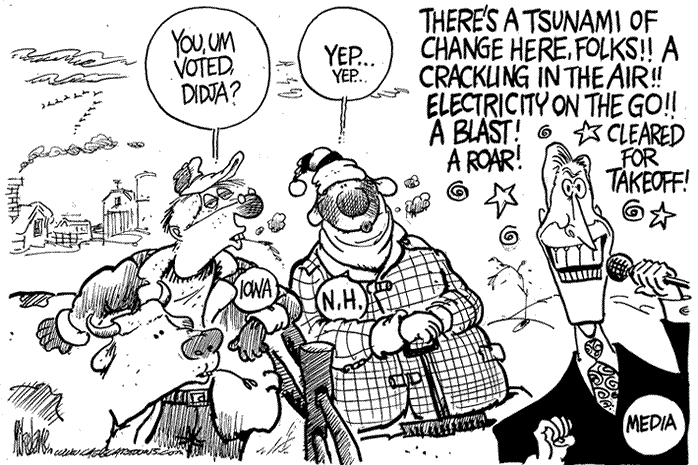
Each media group is a corporation, and the primary function of any corporation is to make a profit. As a business, first and foremost, the media operates on the basic economic principle of supply and demand. The more the consumers wish to hear about a certain story, or issue, the more stories are published. This, in turn, generates greater profits for the corporation. With news outlets such as NBC reporting revenues of $155 million in 2004, it is obvious that the money that can be made is astronomical (Network TV Economics). Another example, according to estimates made by SNL Kagan, a financial research firm, showed that CNN and CNN Headline News, Fox News, and MSNBC were projected to earn a combined $791 million in 2007. This represents a 20% growth of the $657 million in profits made by the three cable news networks in 2006 (Economics). The brilliance of the media is that everyone wants to be informed. The public will always desire knowledge, and the fact is, that there will always be something to report. The media has become so efficient at delivering information that they never seem to have a dearth of it. Thanks to the media’s efforts, it is now almost effortless to become informed of the day’s occurrences. All it takes is the press of a button, the click of a mouse, or the turn of a page. This creates a knowledgeable, modern member of society who is well-versed in the recent news. He or she can hold his or her own in a conversation about global warming in an elevator or about Barack Obama’s healthcare policy on the train back from work. The media brings the world to society’s fingertips and makes huge sums of money while doing so. The media does have some tricks of the trade that increase its necessity in everyday life. These tricks become very useful to news executives because they help increase the corporation’s revenues.
http://www.stateofthenewsmedia.org/2008/narrative_cabletv_economics.php?cat=3&media=7
The media cannot provide such a vast amount of information without one of the cleverest policies news groups implement today: bipartisanship. The value of unbiased reporting cannot go unnoticed. The reasons behind why the news media does not readily choose sides are just another illustration of its genius. The media attempts to be bipartisan in order to maintain its large consumer base. If a media outlet overtly admitted being liberal, or conservative, an entire portion of the market would be locked out. For example, liberals would not prefer to watch a conservative news station, or read a conservative newspaper, and vice versa. Bipartisanship gives the illusion of a conciliatory attitude towards the news and puts on a friendly smile to address questionable arguments. If the media takes sides, then they will make less money. This thought process is plain and simple to understand. The media acts as a business in a stunningly cunning fashion. All of its actions are calculated in order to make astonishing sums of money, while providing information for the masses. The media’s ability to consistently rake in huge profits identifies them as institutions with great networking capabilities that are present all over the world.
The next of the three functions of the media is its operation as a provider of information. With the broadening of globalization and media expansionism in full force, the news divulges more information than people can imagine. Every news source maintains a staff of correspondents, reporters, writers, and editors on call in large cities all around the world. Indeed, the world is truly becoming a smaller place thanks to the media’s influence. For example, CNN currently employees more than 100 reporters for its television shows aired in the United States alone (Anchors and Reporters). There are well over 100 other reporters that work for CNN, broadcasting the news for other nations. Reporting the news is a 24 hour a day, seven days a week job; it never ends. When the sun is setting in one part of the world, the sun is rising in another. The media will never have a shortage of information to provide its audiences. The media is a purveyor of a good that can never be depleted. This fact not only contributes to the media’s business aspect of making money, it creates a new, more vociferous persona for the media entirely.
The media’s expansive networks all over the globe, combined with its ability to report on nearly anything it or the public deems newsworthy, makes the media a powerful interest group. News sources take this interest group persona to an entirely new level. Since there are news mediums that tend to naturally be more liberal or conservative than others, the interest group mentality becomes much stronger. This means that an underlying tone is present in how each specific news outlet reports. As an interest group, with the means to provide information comes a motive. The media can easily spin stories in ways that benefit one political party over another. The title of “interest group” only catalyzes the media’s capability to become one of the most influential forces on the opinions of a nation’s citizens, especially during Presidential elections.
The final, most crucial role, of the media is that it is an almost omnipotent sculptor of opinions. The media clearly exercises an enormous amount of influential strength. They are able to reach every person on this planet with access to a newspaper, computer, or television. This ability to influence such a large audience of people is something that Presidential candidates cannot do, at least as effectively, even if they tried. The media can undoubtedly alter the opinions of a nation because they wield such a vast amount of power. This authority is most evident during election years. The media functions as a gatekeeper, deciding what to report and broadcast in the news. This role enables the media to keep a tight reign over what becomes main stream for the public (Hall and Hardy 118). Thus, during an election, the media controls what the voters will become cognizant of. Even at this elementary stage of reporting the news, the media can mold public thought. For example, during the 2008 United States Presidential Election, the media, for the most part, decided to focus more on Barack Obama’s connection to Reverend Jeremiah Wright, and not to make as noteworthy Obama’s connection to Bill Ayers (Obama Outraged). Operating as a gatekeeper is just one part of what makes the media a molder of opinions during and beyond election seasons. Thanks to media groups’ networking capabilities, they bring the world to the voters with ease and with their own opinions mixed in. Simply put, the media does something that the general public cannot easily do: research.
The media also alters opinions due to the simple fact that a majority of voters lack the time, energy, and resources to conduct their own inquiry and research into a candidate or an issue. This inadequacy on the part of the voter leaves him or her to succumb to whatever information is laid out by the news outlets. This unfortunate truth demonstrates the concept of information costs. The basic tenants of information costs work in cohort with the concept of the gatekeeper. The media decides what the main issue of an election will be (Hall and Hardy 117). If we look past an election year, the media can even define the ideals of a generation through what they decide to report. For example, during the Vietnam War, the media could not get enough of the rebellious actions of anti-war protestors. This issue, in retrospect, came to define that generation (Vietnam Protests). The media uses a basic concept to generate mighty influence. Yet, there is another piece to the puzzle, which further solidifies the media’s predominance in public opinion.
The principle of agenda setting ties into the principle of information costs to define what the issue of an election will be. The media can dramatize an issue to the point that voters will formulate their own thoughts on it. Typically, this issue goes on to define the election and manifest its repercussions. For example, the focus on the wars in Afghanistan and Iraq during the 2004 United States Presidential Election came to the forefront of ideological battles during that period. The wars became the underlying issues that were constantly on the minds of voters thanks to the media’s ability to agenda set (War’s Rationales). Likewise, during the 2008 United States Presidential Election, the economic crisis received much of the media’s, and therefore the candidates’ and voters’ attention. Though it may be a little too early to tell what the defining debate issue of the election will be, the economic crisis U.S. citizens and businesses faced in the waning moments of the election may come to define it (Issues). Agenda setting plays a complementary role to the presidential campaign ad in that it highlights the key concern of an election. Furthermore, this concept ties in with every other aspect of the media’s role as an influential entity and an architect of opinions. These concepts blend together harmoniously to give the media unlimited access to the minds of the public. This limitless access may be a very dangerous end to reach. For the sake of the voters, the media must not become a near almighty being.
It is very easy for the media to engender information in the minds of the public and for the public to accept what they are told as truth. This is a fact that the media is well aware of. The pubic cannot break free from the media’s influence even if it tried to do so. This is a disconcerting thought. To know that the world is subject to what they can see and hear through the media is frightening. In reality, society is at the whim of the media’s word. Collectively, the news outlets hold a monopoly on information itself. They can charge us what they want to use it, broadcast what they deem worthy, and twist stories in any way they wish. With all of the media’s basic principles and business strategies working together, endless influence exists. It is vital that we, as members of society, formulate our own opinions. We cannot continue to absorb what the media lays out. It is dangerous on a myriad of levels. Most conspicuously, becoming a slave to the media will alter our own beliefs, perhaps for the worst. We may no longer think for ourselves if the media is allowed to run rampant. Just as importantly, the foundations of society as a whole may be shaken, due to the media’s vast authority. If the media can change our opinions, then it has the innate ability to change who we vote for. All the general public can do in order to change the current state of the government, short of a revolution, is to vote for change. The media may very well shape our opinions in such a way that we end up voting for someone who is not beneficial for us in the long run. The politician does not control who we vote for, the media does. The media is the middle man between the politician and the voter. Due to this position between the leader and the people, the media can interpret what the politician is conveying for the citizen. This would, in turn, alter the course society is taking, possibly for the worst. We must be wary of the power we allow the media to wield so casually; it may hurt us in the end. The media’s burgeoning command over our thoughts takes hold during not only election years, but at any given point of our lives.
Election years aside, the media controls thoughts and opinions in everyday life as well. For example, if a newspaper chooses to print an image of flag-burning protestors on the front page, along with a lurid headline, it will provoke thoughts of confrontation and destruction among its readers. The newspaper could have easily published a similar story, but instead of images of violence, printed images of peaceful protestors, fighting for the same cause. If this newspaper chooses to deliver the image of violence, it is only perpetuating conflict (YouTube). From beating the drum of bloodshed extends a fundamental fact. The media publishes headlines that sell. A newspaper with the cover image of a burning flag is far more eye-catching to the consumer than an image of peaceful demonstration. The media can deliberately fan the flames of protest if it means they can grab your attention. Unfortunately, the media not only makes money off of publishing deliberately obscene headlines, it uses them to shift our opinions to the more extreme ends of the ideological spectrum.
Consumers cannot deny that the media plays a key role in the lives of an increasingly massive number of individuals. The media functions as a business, a provider of information, and a molder of opinions. News groups earn more money than the average person can fathom, and with riches comes its inherent ability to influence the world. The media not only provides us with the facts of an issue, it sets forth its own interpretation. The media changes governments and more importantly alters perceptions of reality. The media changes society far surer than any political leader. The media is available at your fingertips every second of every day, and they know it. An interest group that wields this much power, money, and ideological influence will undoubtedly be around for a long time to come. It is up to us as consumers, and more importantly members of society, to formulate our own thoughts when we consume the information that is laid out before us. We must not become slaves to the media. This, however, is much easier said than done.


 Posts
Posts


12 comments:
I feel the diversity of the media provides viewers with enough outlets to piece through bias and find valuable and accurate information. The internet makes this endeavor much easier than it used to be. In regards to media bias, I sometimes wonder does the publics own personal bias distort their views of how bias or unbias the media actually is? I personally view Fox News as an abomination that sacrifices facts in support of the conservative agenda, but many people view it as the most unbias of the political news channels.
On a different note, I have spent some time wondering about ways to eliminate the "ratings grabbing" that news stations do by pumping up news stories to be more than they actually are. I cannot think of any way that would not have worse consequences that infringe on freedom of speech. Can you think of any effective ways?
I agree with the fact that the media is inevitably biased due to the fact that it is a business. Although many outlets may offer "unbiased" information, the majority of their focus is still on money making headlines. The internet and various media outlets do allow the diligent people to see all the views out there and come up with their own opinion. But let's face it, most people are too lazy to do that. They simply form their opinions on the first few things they hear, no matter how reliable or unreliable the sources are.
1. What do you think is the most reliable source for factual, unbiased news?
2. What can be done to make the media less biased?
I am not sure I completely agree with your statement that people have an underlying need for information, and the media is the answer to that need. I think that there always has been, and always will be, people who are curious about their surroundings, but in the times before mass media, I think people did just fine not knowing all about what was going on in the world.
That being said, I think you make a strong argument about how effective the media can be in influencing opinions, which makes the case that biased media can be dangerous to society. Overall, it is a strong argument. At times, the post got a bit wordy, but it was still a very engaging read. Nice job, Alex
love the project, I agreed with you for the most part. (my project was similar to yours)
1)the influence of the media is very apparent, but do to networks biases is this influence justified??
2) Government censorship in countries such as China have proven to create a more seemingly "unified" nation. do you feel that "ignorance is bliss" and that at times media censorship can actually help a nation?
While I agree that media is inevitably biased because they are also corporations, I believe that there are enough sources out there today that people can often choose what they want to hear. Pluralism is a good thing but nevertheless, I cannot deny the extraordinary power that the media has in terms of influencing people's thoughts in a free speech nation like America.
What do you think the worst case scenario that could result from overly biases in media and the lack of pluralism?
Do you think the existence of the internet and the use of free speech blogs will make more people cautious when observing mass media?
I thought that your argument was very well presented. I especially liked how you presented the three different facets of the media and the effects that they have on the American people as a whole. The big name news stations that we generally get our news from certainly have a large advantage when it comes to research, interviews, and resources in general. However, I would have to agree with Jake in the respect that the variety of of news stations gives enough sources to gain a fair report of any story.
Do you believe that the multitude of news sources, which are growing each day, bring more or less partisanship into the reporting of political events?
My second question relates to the cartoons that you passed out before your presentation. Do you feel that news sources have a responsibility to report on events that merit attention? In other words, should the media have more coverage on crisis in Indonesia than the Michael Jackson trial?
I totally agree with your point that news is in fact a business, and as always a business's one priority is to make money. It is also interesting that you pointed out how the media has a monopoly on information just as any other firm in today's market can have. And I do agree it does influence people, though I'm not sure it does to the extent you indicated. For instance, the people in our class can see right through the media's bias on both sides. Who is to say there aren't many more people just like us?
If there is a variety of news shows covering all perspectives do you think people should take advantage of that and get all of these perspectives to take away their own thoughts on the information?
Your project was well thought out and researched. I liked how you backed up your information with graphs and data. I also found the second cartoon in the handout to be absolutely hilarious.
I also found it interesting how you said the media has a monopoly on information. I agree with this as well. Without the media, the transfer of information worldwide would be gone and we would basically be isolated from the world.
What would happen if the information on the media was no longer free? Would other forms of media reemerge or be created?
Will information on television dwarf to those online in the next few elections? or will the amount of viewers stay the same in each category?
Alex, your argument was very well conceived. We should all constantly remind ourselves of the power that the media holds as the gatekeeper, scorekeeper, and watchdog. It was announced today that Obama spent around 720 of his 754 million dollars during his campaign. A large percentage of that went to campaign ads in the media. Obama recognized the same power that Alex did, and he utilized it. Your presentation type was also extremely clear.
1. Do you think that the money candidates pump into the media fuels its ever-rising power?
2. What can be done to place limitations on what seems to be an exponential growth of media influence?
Alex, i think you did a great job of presenting your argument and collected data. I agree completely with you, in that the media is a business and people must keep that in mind when receiving information from various sources.
It is clear that the media has a strong force over the public but is this "Monster" strongest in different forms. Does the television hold a stronger influence than newspapers and magazines? Or is the internet the strongest because it is the most easily accessible?
Would the news be less biased if there was less competition between stations?
I generally agree with the points in Abedine's argument regarding the media's influence on people. I also feel that a biased media is inevitable. However, I don't feel that a biased sourced exactly means biased information. Sure, although many media sources present information with a certain bias, I believe that the people should ultimately be held accountable for whether or not the bias aspect of the information is retained. An educated and critical audience is one that can eliminate the detrimental effects of bias.
Questions:
1. How can subjectivity in the media be avoided? Can it be?
2. Why is an objective news source more accurate than a subjective one?
I think Alex's project made some very good points. People often ignore that the first objective of news companies is to make money, and that such a goal influences how they deliver news. I also thought that recognizing news as a commodity and news stations as providers was interesting. Many people just consider news something that's available to the public, not a commodity controlled by a powerful few. However, I do wonder if people are now more conscious of the biases in media and therefore are less influenced by them.
Post a Comment